Willow, Rush or Straw for a Small Basket
Choose willow, rush or straw for a small basket by matching each fibre’s flexibility, texture and handling to the shape and finish you want.
Which fibre will make a small basket easier to shape and pleasant to look at? For a simple decorative basket, willow, rush and straw each offer a different balance of bend, texture and visual weight. Start by deciding what you want the finished basket to look like, then choose a material that suits the form and the way you want to work.
Choose the basket’s character
A small basket can be open and airy, tightly woven, smooth, or visibly rustic. Those qualities come partly from the weave, but the fibre sets the starting point: how readily it curves, how much surface texture it shows and how prominently individual strands stand out.
Willow usually makes a defined, sturdy-looking weave. Its rods form a clear frame and its thinner rods can be woven around that frame. Rush is softer in appearance and often works well when you want rounded, continuous coils. Straw is light and bright, with a dry, crisp look that can give a basket a more delicate, handmade character.
Before buying or gathering material, sketch the shape and note whether you want visible gaps, a solid-looking wall or a rounded profile. A simple decorative basket does not need to carry heavy objects, so appearance and manageability can lead the choice.
Match fibre to form
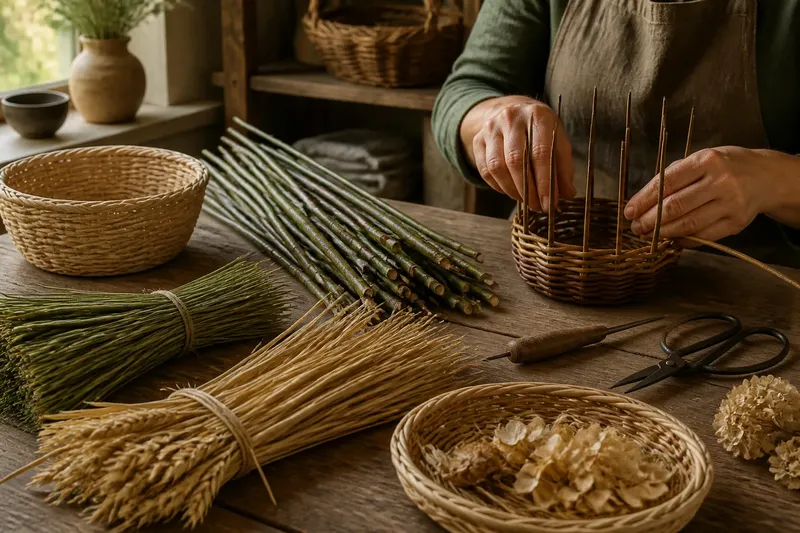
Willow is a natural choice for a basket with a distinct base, upright stakes and woven sides. The thicker rods can form the basic structure, while thinner rods pass around them. Willow’s linear form makes this construction easy to read: the frame and the weaving remain visually separate.
Rush suits a coiled basket, where a soft bundle is wrapped or stitched into successive rounds. It can make a rounded bowl or a low-sided container with a gentle outline. Because rush is often handled as a continuous, flexible length, it can create a surface that feels more unified than a basket built from separate rods.
Straw is useful for a small, light basket whose appeal comes from its fine, dry texture. It can be coiled or combined with a supporting structure, depending on the straw type and the technique. A tight, compact weave may need carefully selected, even pieces; a more open decorative form can accommodate a looser, more varied surface.
Say you want to make a shallow basket for holding dried flower heads. If you prefer visible upright ribs and a firm outline, choose willow and plan a simple stake-and-weave form. If you want a soft, rounded surface, choose rush and build in coils; if a pale, delicate appearance matters most, choose straw and keep the form small enough to handle comfortably.
Compare handling qualities
Willow: Rods can be sorted by thickness, which helps you assign heavier pieces to the frame and finer ones to the weave. This distinction is useful, but it also means you need to manage separate pieces and keep the frame evenly spaced. Willow’s natural curves and taper can make the finished pattern look lively rather than perfectly uniform.
Rush: Its softer, rounded form lends itself to a repetitive coiling motion. You are less likely to see a framework of individual stakes, although the basket’s shape still depends on consistent spacing and tension. Rush can be easier to adapt to a curved outline, but a change in the thickness of the bundle may show in the surface.
Straw: Individual pieces tend to be slender and visually crisp. That can produce a neat, light effect, but uneven lengths or thicknesses may interrupt the pattern. Straw can also be less forgiving of abrupt bends than a supple rod or bundle, so a gentle curve and modest scale are sensible choices.
For any of the three, handle a sample before committing to the whole project. Look for a fibre that bends in the way your chosen form requires, without breaking or becoming awkward to control. The label, supplier’s instructions or local rules determine suitable preparation and use; follow them where they apply.
Prepare a manageable batch
Sort your material before weaving. Keep the straighter, thicker willow rods together for structural pieces, and separate finer rods for the sides. With rush or straw, set aside lengths that are reasonably similar in thickness and condition; consistent material makes it easier to maintain a steady-looking surface.
Clear a table or workbench so long pieces can lie without being sharply bent. Keep a small pair of scissors or pruning shears nearby for trimming material where appropriate, and use a blunt weaving tool or awl only if the chosen technique calls for one. A shallow tray can keep short pieces from rolling away.
Do not try to correct every natural variation by forcing the fibre. If a rod resists a curve or a strand seems too brittle for the shape, set it aside for a straighter or less visible part. A basket often looks more coherent when its irregularities are distributed rather than gathered in one place.
Build the shape gradually
For willow, begin with a small base and place the upright stakes at even intervals. Weave a few rounds loosely enough to adjust the spacing, then check that the sides rise without leaning. As you continue, alternate the starting point of new rods when the technique allows; this helps avoid concentrating joins in one spot.
For rush, form the base as a coil and add each new length in sequence, keeping the rounds close together. Shape the sides by placing later coils slightly above and inward from the previous round, or use a gentler curve for a shallow bowl. If the coil begins to flatten or bulge, pause and adjust its position before continuing.
For straw, work in small sections and keep the direction of the pieces consistent with the pattern you have chosen. Avoid pulling a strand sharply around a tight corner. A simple, compact shape with a broad opening is generally easier to manage than a narrow neck or an intricate profile.
Whichever fibre you choose, pause often to view the basket from above and from the side. A small shift in spacing is easier to correct before more material covers it.
Which fibre suits your project?
Which fibre is easiest for a first basket?
Choose the one that matches the construction you want to learn: willow for a clear frame-and-weave form, or rush for a continuous coil. Straw can also suit a small project, especially if you favor a light surface, but it asks for gentle handling and reasonably even pieces.
Can these fibres be mixed?
They can be combined in a decorative piece, but their different thicknesses and surface qualities may make the transitions conspicuous. If you mix them, give each a clear role, such as willow for the frame and a contrasting fibre for a small accent, rather than switching materials unpredictably through the weave.
What if a fibre keeps splitting or breaking?
Set aside pieces that will not bend comfortably for the shape you are making. Check that you have not chosen a curve too tight for the material, and try a simpler outline or a different portion of the batch rather than forcing the strand.
Which one gives the smoothest appearance?
That depends on the material’s consistency and the weave. Rush can produce a continuous, rounded surface, while well-matched willow can create orderly rows; straw can look neat and fine when its pieces are similar. Inspect a few sample lengths and let the texture you prefer guide the decision.
Finish with a clear edge
The rim is a prominent feature on a small basket, so keep its finish in keeping with the rest of the design. A willow basket can use a simple turned or woven edge suited to its frame. A coiled rush basket can finish with a final, neatly secured round; a straw basket may look best with a restrained edge that does not overpower its fine surface.
Trim only where the construction calls for it, and tuck or secure loose ends according to the technique and material. Place the basket on a level surface and check that it sits as intended. If the base rocks, adjust the shape gently before the material has settled into its final form.
For a first decorative basket, let the material decide the project’s scale: willow for a small, defined structure, rush for a soft coil, and straw for a light, fine-textured shape. Choosing the fibre this way keeps the basket’s form and its natural character working together.