A Well-Ordered Store Begins with Seeing What You Have
A well-ordered household store makes provisions easier to spot, count and return, with simple grouping and readable labels that suit your shelves.
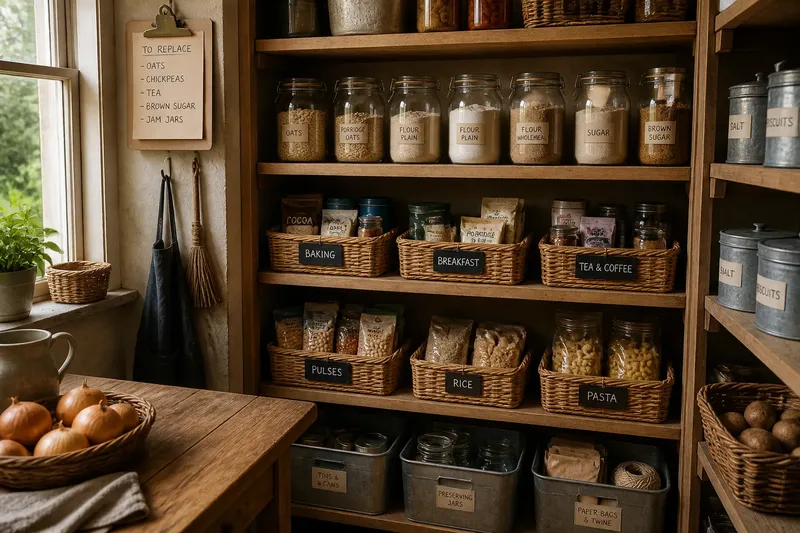
How can you make a household store easier to use without rebuilding it around one ideal layout? A well-ordered store begins with seeing what you have: provisions grouped in ways that make sense to your household, labels you can read at a glance, and stock kept in view rather than hidden behind itself. The aim is not a perfect pantry picture. It is a store where the next useful decision comes easily.
1. Group by use
Put provisions together according to the job they do in your household. Baking ingredients might share a shelf or a crate; breakfast foods could sit near tea, coffee, or the bowls used to serve them. A different home may find it more useful to group foods by meal, or to keep frequently used cooking basics together.
Choose groupings that match how people actually look for things. If someone reaches for oats and dried fruit together, placing them nearby can reduce rummaging. Keep categories broad enough to remain useful: a separate spot for every small ingredient can make a store harder to scan than a few clear groups.
Say you use flour for bread and occasional baking, but keep both in one household supply area. You might place flour with baking goods, then use a small marker or shelf note to distinguish the bread-making portion if that helps. The expected result is that everyone can find the main supply without having to remember a complicated arrangement.
Start with the groupings you already reach for most often.
2. Give labels a clear job
A label should answer a practical question: what is this, and, when useful, what kind or form is it? If a clear container holds several similar grains or powders, the name may matter more than the appearance. For a packaged item, its original label can carry details that a handwritten front label would omit.
Write labels where they can be read while the item is in its usual place. A tag facing the aisle or a label on the front of a jar is more helpful than writing on the back that faces a wall. Use lettering large enough for ordinary room light, and avoid abbreviations that only one person understands.
When transferring provisions to another container, keep relevant package information accessible rather than relying on memory. The right storage method and any handling directions depend on the product label and manufacturer instructions; follow those where they apply. For items that look alike, add a distinguishing word such as “whole,” “ground,” or “unsalted” when it clarifies what is inside.
Make the label answer the question you would ask while cooking.
3. Keep stock in sight
A clear view helps you notice what is available before opening another package or buying more. That does not mean every item must sit in a glass jar. Open-front baskets, shallow trays, and modestly sized containers can make supplies easier to see while still keeping them together.
Where shelves are deep, reserve the back for items used less often and keep the everyday group near the front. Avoid stacking so high that one container hides another. If opaque tins are necessary, a visible label or a simple written contents list can stand in for a clear view of the contents.
Think about the view from the doorway as well as the view at shelf level. A stool, a low shelf, or a narrow container may be more useful than a tall vessel that leaves its contents out of sight. Keep heavy containers in a position that is comfortable to reach; a household store should be legible to the people who use it.
Move a container if seeing it requires shifting several others.
4. Make returning items easy
A system works only if provisions can go back to their places without a small household puzzle. Leave room for the containers you actually use, and avoid assigning a shelf so tightly that one new packet forces a full rearrangement. A basket or tray can define a group without requiring every item to line up precisely.
Use a broad, visible home for items that arrive in different package shapes. For example, a “pulses” basket can hold bags of lentils and beans even when their packaging differs. If a category keeps spilling beyond its space, consider giving it more room or dividing it by a useful distinction rather than pressing packages into an unstable stack.
It can help to agree on a few plain names for places: “tea shelf” or “baking basket” is easier to remember than a system based on private shorthand. In a shared kitchen, that small consistency means someone else can put supplies away without asking where each one belongs.
5. Let the store show its gaps
Visible stock is useful not only for locating provisions but for noticing what is running low. A space that is plainly empty can prompt a decision, while a shelf crowded with mixed packages can disguise a shortage. You do not need a formal inventory if a quick glance gives you enough information for the next shopping or preparation choice.
Keep a short note near the store for items you want to replace, if memory alone is unreliable. Write the item name as soon as you notice the gap, then remove it from the note when it comes home. The list is a prompt, not a second record that must be kept perfectly current.
Use this approach for recurring household supplies too, such as preserving jars or paper bags, if they share the storage area. Keeping them distinct from food avoids confusion while letting the space show what is ready for use and what needs replenishing.
Questions about store order?
Should similar foods always sit together?
Usually, grouping similar provisions makes them easier to locate, but the most useful category depends on how your household uses them. Keep a group together when that makes retrieval clearer, and separate it when one broad category hides important differences.
Are clear containers necessary?
No. A readable label on an opaque tin or a visible contents list can provide the information a clear container would show. Choose containers that suit the provisions and the space rather than replacing sound storage just for appearance.
What belongs at the front of a shelf?
Place items you reach for regularly where they are easy to see and return. Less-used supplies can sit farther back if you can still identify them without unloading the shelf.
How should a shared store be labeled?
Use familiar, direct names that everyone who uses the space understands. If a label needs a private explanation, simplify it or add the distinguishing detail that makes the item clear.
A store that reads clearly
After arranging the provisions, look at the store from the position where you normally choose what to use. Can you identify the main groups, read the labels, and see what is running low? If not, adjust one shelf or basket at a time. A well-ordered household store is not a fixed design; it is a useful view of what you have, shaped around the habits of the people who rely on it.